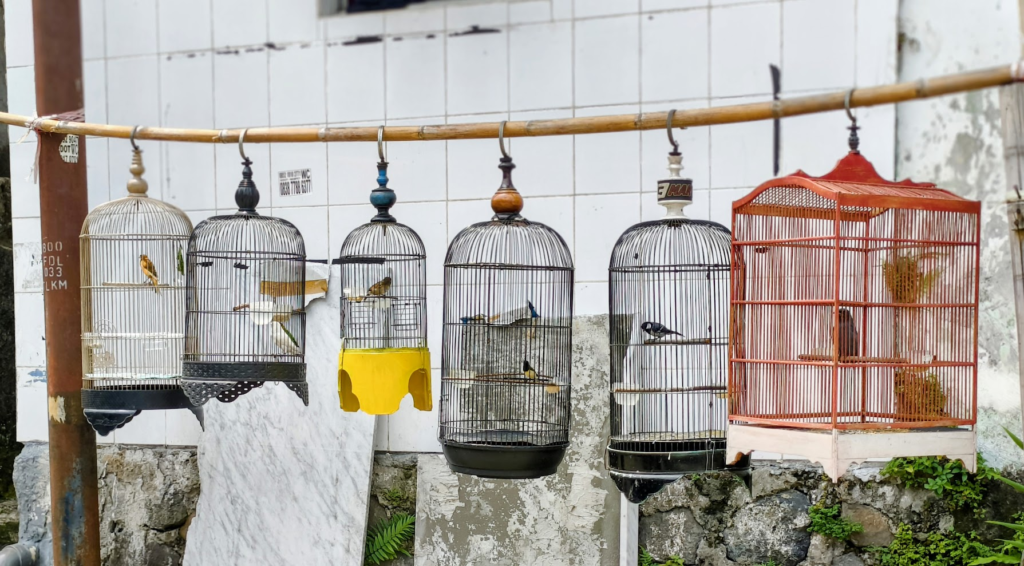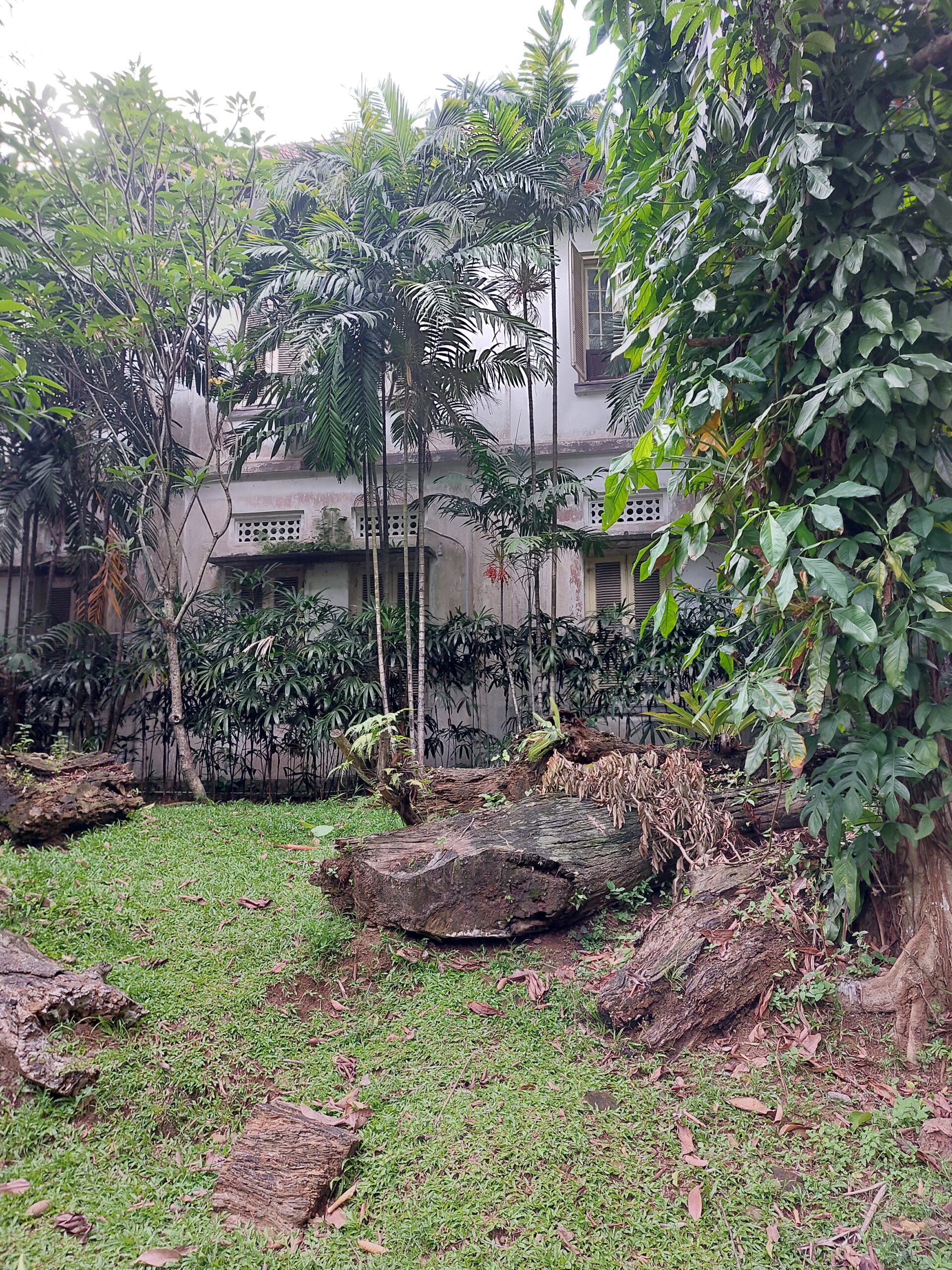
“A visit to Bogor is the best way to escape busy, hectic, smoggy Jakarta.“
Right!
Although captured partially by the continuously growing capital city, Bogor is – and always was – a backdoor for Jakarta residents & tourists alike. A “green backdoor“, you could say.
Mainly because of its beautiful Botanical Garden or Kebun Raya. For most visitors its biggest attraction & main reason to visit Bogor.
- !!! As this is an extensive blog post, I’d like to recommend you to have a look at the Index first. This way, selecting the topics that are of interest to you.
Our Visit to Bogor: Introduction
Me and my wife Wendy visited Java & Bali in October-November of 2025. An old wish. Especially as Wen’s father was born on Java & had regularly inspired her in the past – and later me also – with his youthful memories.
- I will refer to this personal history whenever we felt treading in the family’s footsteps.
In this post I will tell you why a visit to Bogor is the perfect start for your journey through Java. Certainly when you’ve planned to include the nearby capital Jakarta in your itinerary.
- The distance between Central Jakarta (Merdeka Square) and Bogor is 60km/ 37mi. Well over one million inhabitants live in Bogor nowadays.

- IMPORTANT MESSAGE: Throughout this post you’ll find affiliated links & ads provided by the travel platforms like Expedia & GetYourGuide. Links & ads that may help you plan & fill in your next trip to Indonesia.
- If you click on them & buy a ticket for a museum or a tour a small commission of your purchase will go to me (Paid by the provider, without any extra cost to you!).
- If you first want to learn a little bit more about me, the blog writer, please click on: Better call me Art.
Short History of Bogor
As Jakarta, Bogor has a long history. An interesting past you may want to learn about before you explore its visible & invisible remains.
- !!! Before visiting a certain place, it’s good to learn about its history. However, if you already know about Bogor’s past. Or aren’t that interested for the moment, click on the next segment: Things to do in Bogor.
Early History of Bogor
Although no concrete traces have been found so far, we shouldn’t rule out a prehistoric human past. Referring mainly to the spectacular discovery of “Java Man” in Central Java during the 19th century.
Pre-Colonial period
The first mention of a settlement at present Bogor dates to the 5th century. At the time, the area was part of the Hindu Kingdom of Tarumanagara.
Two centuries later, Tarumanagara, was conquered by the neighboring Sunda Kingdom (also Hindu). A bigger empire which rapidly grew in importance.
Knowledge historians partially collected from big standing stones or steles (“prasasti“) which the Sundanese often used to record important events.

- These stone monuments are found all over Northwest Java. The most famous one is the Prasasti Batutulis. A stele which in the past marked the city center of Bogor. At the time known as Pakuan Pajajaran.
During the 15th century Bogor/Pakuan Pajajaran even became the capital of the Sunda Kingdom. A title it would lose almost a century later – in 1579 – when the city was captured by the Islamic Kingdom of Banten.
Marking the end of the legendary Sunda Hindu State. As well as the conversion of its inhabitants to the Islamic faith.
Pakuan Pajajaran itself was largely abandoned & soon reclaimed by the surrounding jungle.
Dutch colonial period
During the 16th century European traders arrived at Java’s northern coast.
It was the Dutch who won the (commercial) battle with the Portuguese & the English. Settling their main base at a place they named “Batavia” – modern day Jakarta.
At the end of the 17th century the Dutch rediscovered the last remains of Pakuan Pajajaran. Converting the area soon enough into a lively place again. Foremost a welcome escape of “deadly” Batavia.
A mountainous country retreat. That is, a much greener, cooler & healthier area than their main base on the coast. Although also a wetter place.
- Bogor is still known as the Rainy City – “Kota Hujan”.
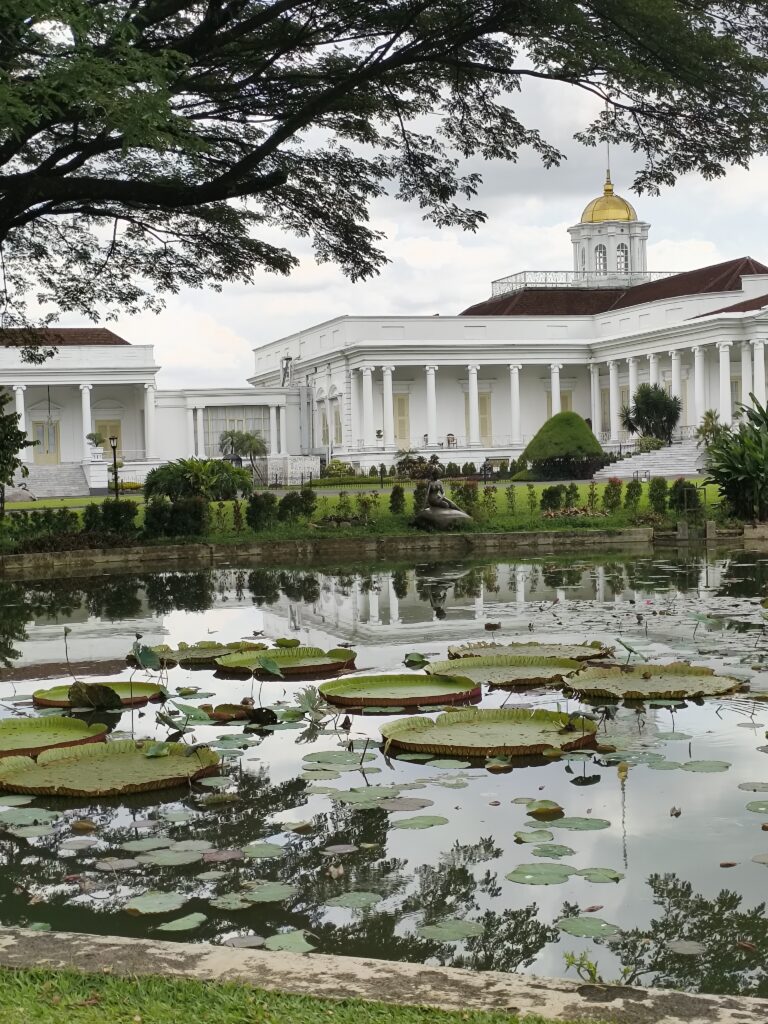
During the colonial era, Bogor was named “Buitenzorg“. Meaning literally “without worries”. The Dutch Governor-General had his Summer residence there.
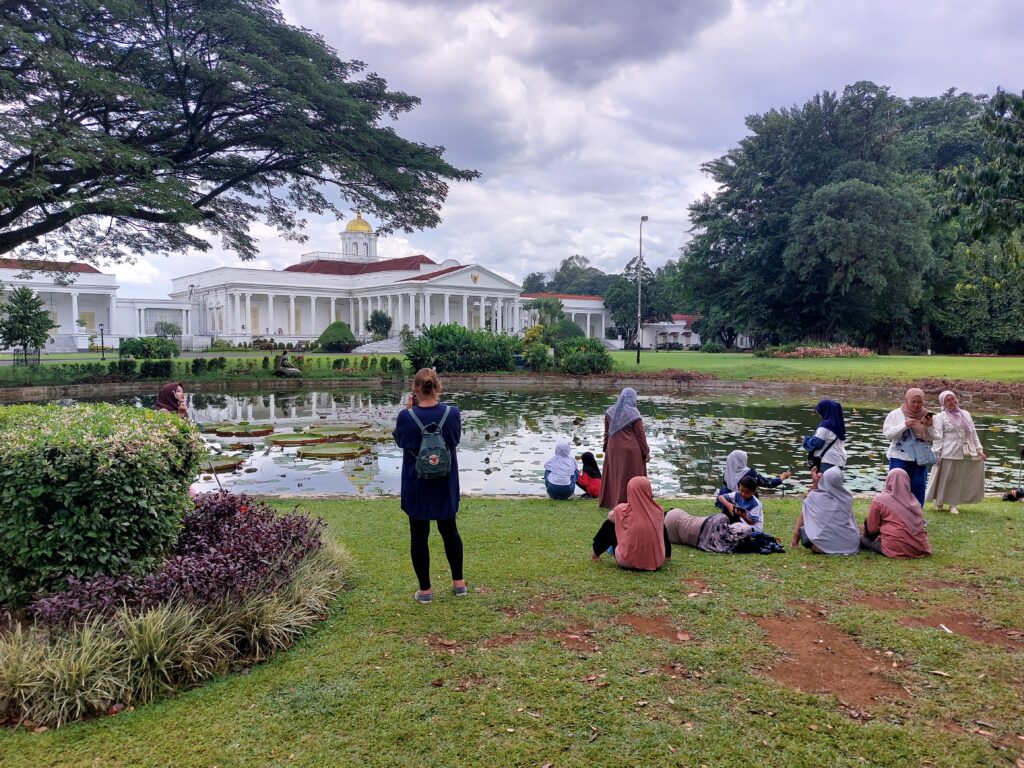
- Indonesia’s first president, Sukarno, converted this residence into one of his Presidential palaces. It’s still standing prominently in the center of Bogor’s Botanical Garden.
The Republic of Indonesia
After Independence (1949) the Indonesians changed the city’s name to Bogor. A name with no clear translation. There’s a possibility the locals simply adapted the Dutch name to the easier-to-pronounce “Bogor”.
Although still rainy and much busier with people & traffic nowadays, Bogor still receives many visitors. Capital residents, as well as tourists who are attracted by its more relaxed atmosphere.
Visit Bogor: Things to Do
Bogor’s Botanical Garden
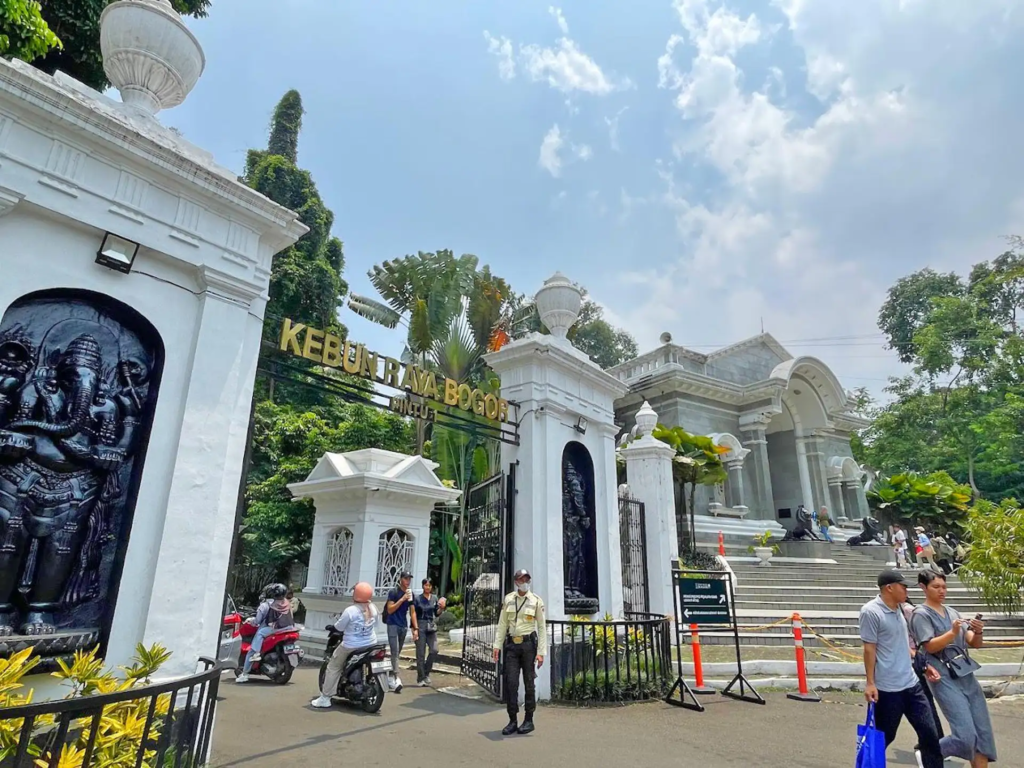
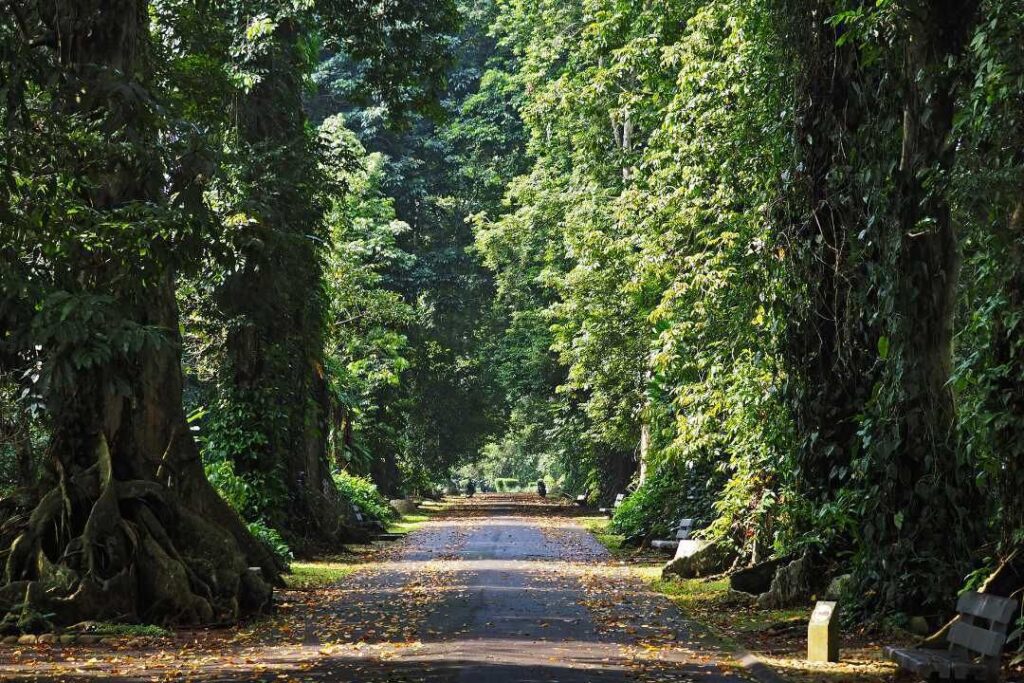
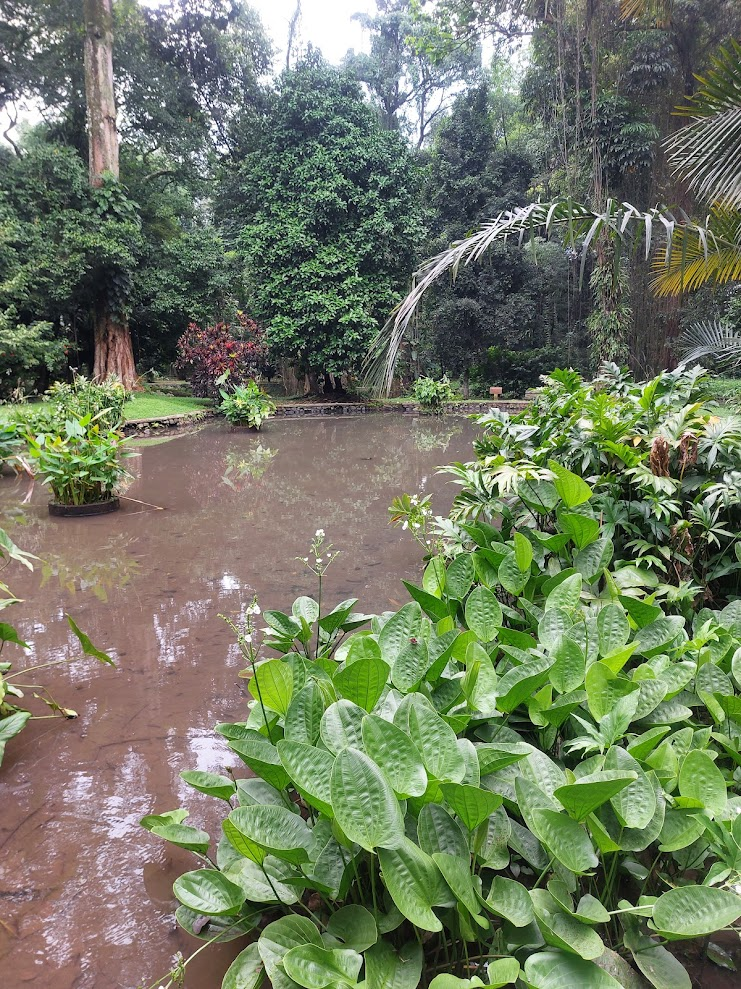
By far the biggest attraction in Bogor: the world-famous Botanical Garden Locally known as the Kebun Raya Bogor.
This 87-hectare green area is conveniently located in the heart of Bogor. You can easily spend a day there. Certainly when you plan a picnic. Or else, include a visit to the Grand Garden Cafe.
- The Botanical Garden was created by the English Governor-General Sir Thomas Stamford Raffles. Its layout is inspired by the famous Kew Gardens in London. It opened its gates in 1817.
The Botanical Garden is home to over 15,000 species of trees & plants. Grouped in themed sections, including an Orchid House, a Palm collection, a Bamboo garden & a Mexican segment, amongst many others.
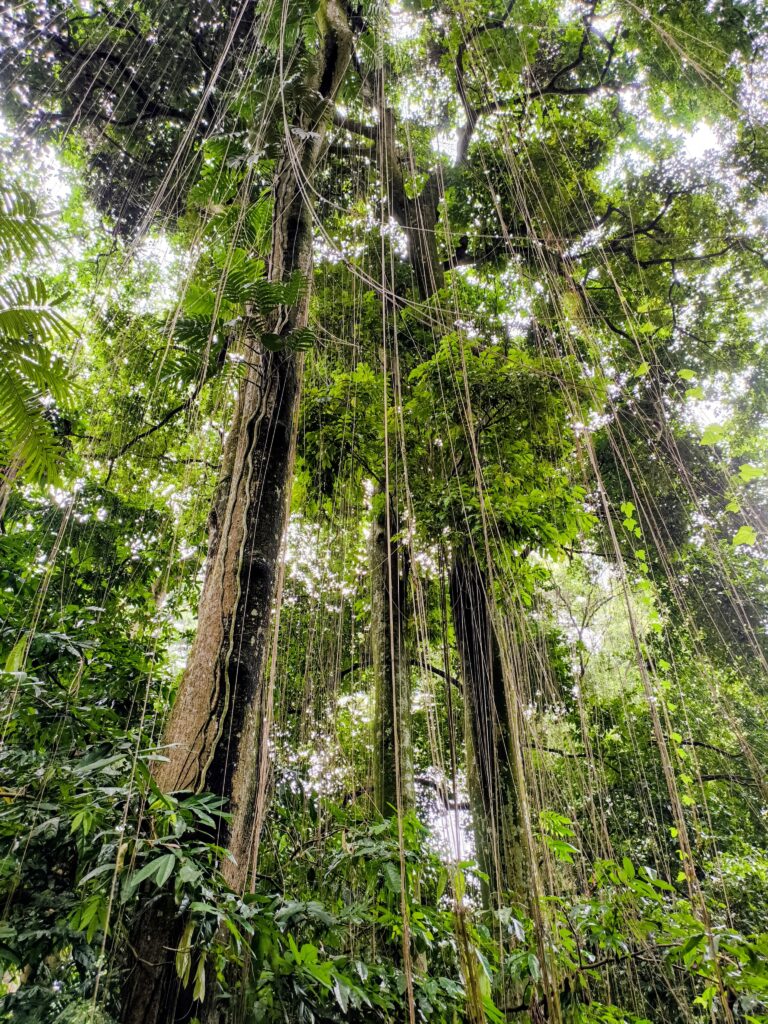
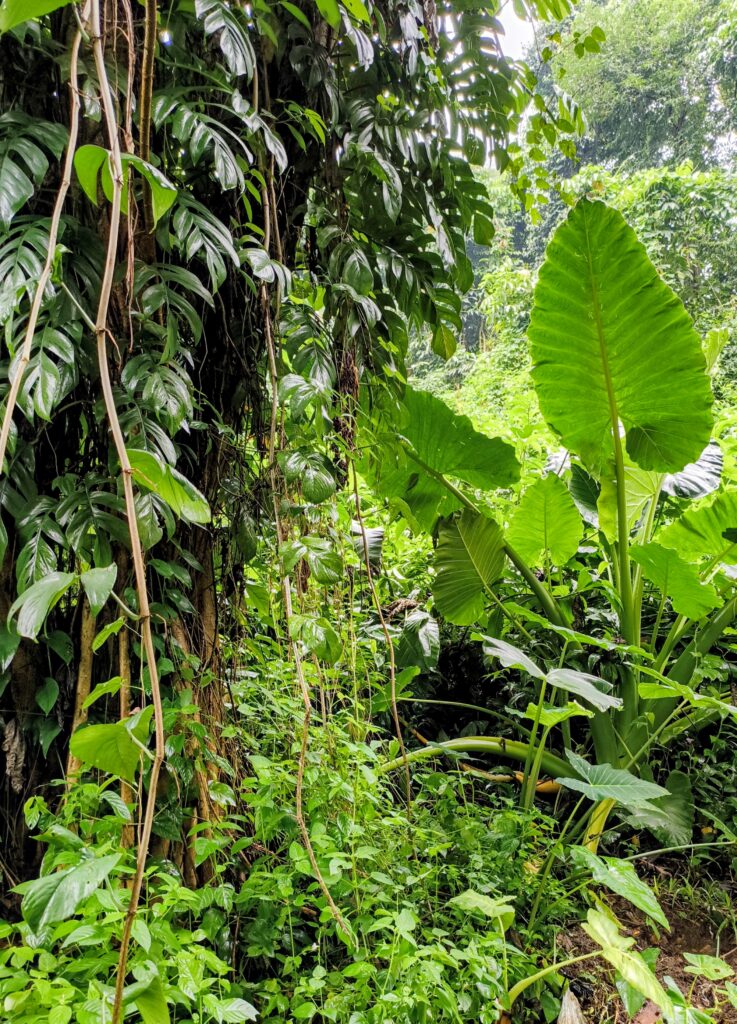
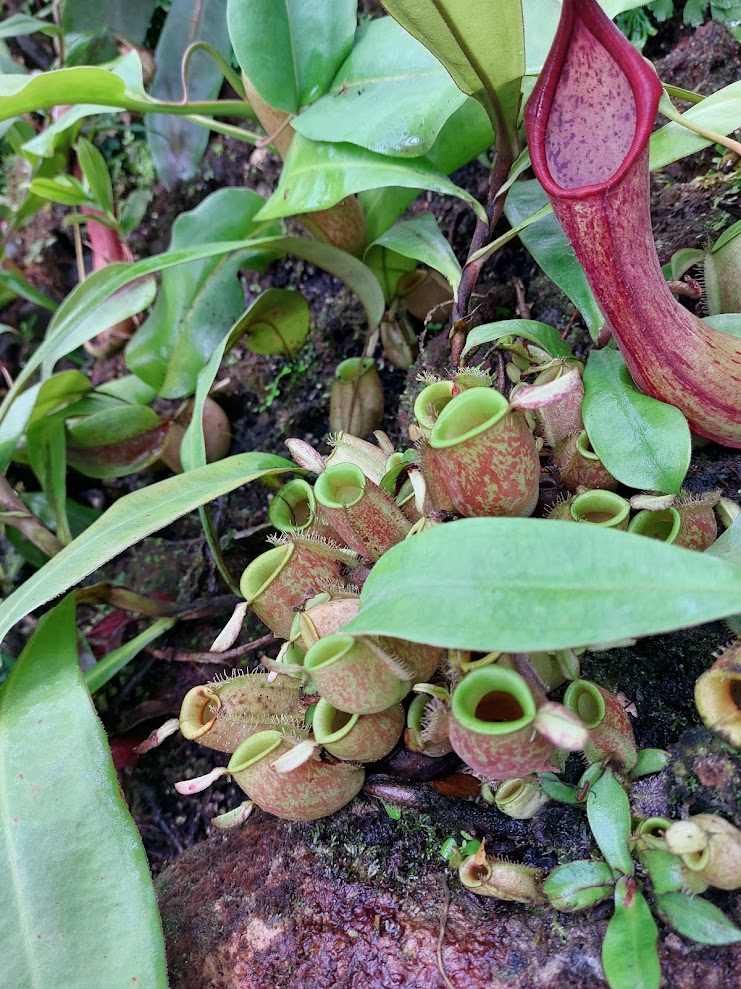


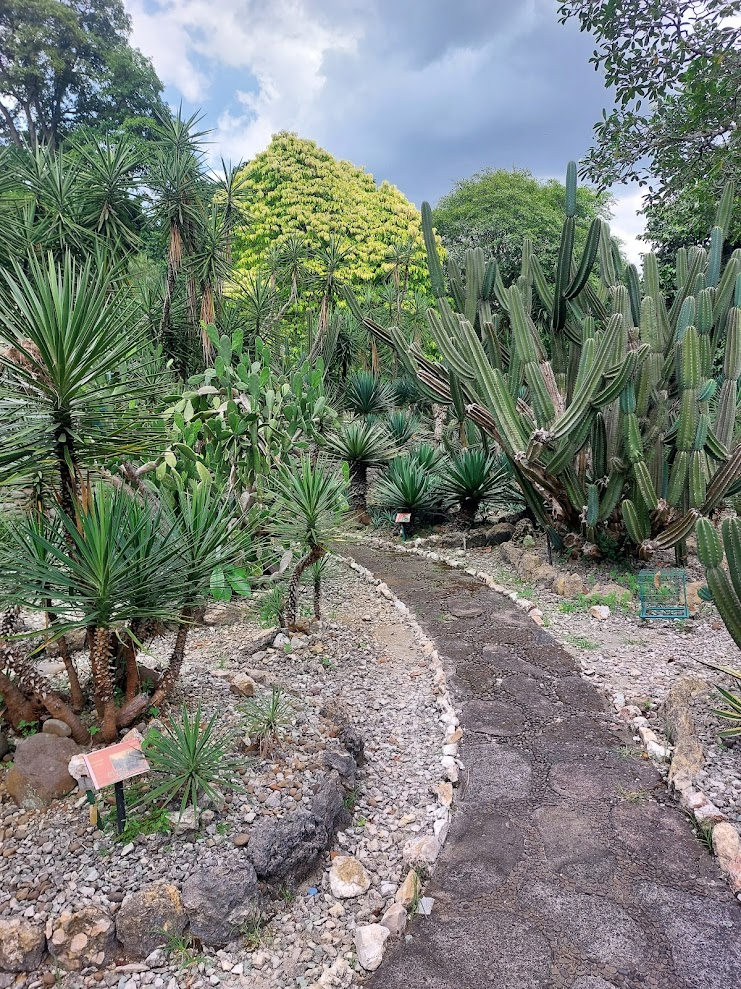
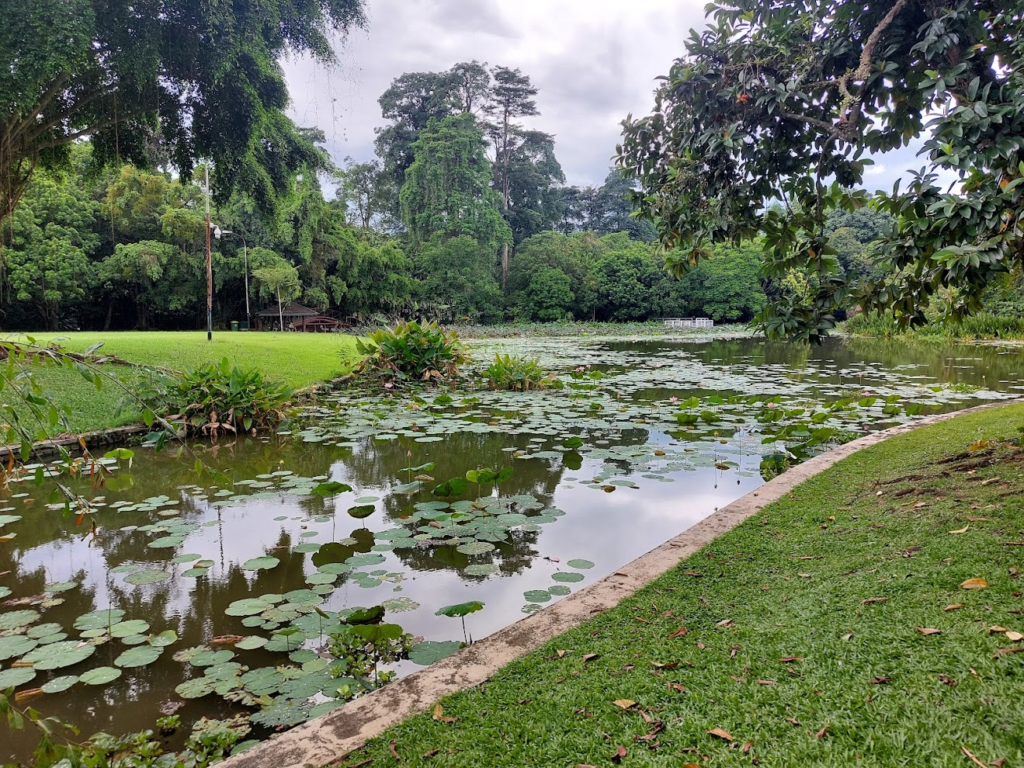
Besides a place for people to relax, it’s – and has always been – a field of study for botanists and other scientists. A laboratory for specialists & students alike.
Museum of Ethnobotany
Something you can learn about at the Museum of Ethnobotany or Munasain (Museum Nasional Sejarah Alam Indonesia). Located just outside the main entrance to the garden. A 10 minute walk.
- There are 4 gates to the garden, but only 2 are open to visitors. The main gate, #1, is located at the southern end. Gate #3 at the opposite side.
Although this museum needs serious attention, we got a good idea of the role the garden played for people who wanted & want to study the flora & fauna of the area.
- Most rooms were poorly lit & some were even leaking.
- In addition, all exhibits were described only in the local language, Bahasa. While – I think – nowadays English is a requirement in such an important museum, open to all.
TravelTips: We solved the language problem by using Google Translate. Taking photos of explanations we were interested in. An excellent solution, but somewhat cumbersome.
Back to the Botanical garden…
During the colonial period most scientific work at the garden was led by foreigners. Mainly Dutch, but also German & British scientists.
After Independence this role was taken over more & more by the Indonesians themselves.
- Several of the European scientists who worked at the Botanical garden are buried there. Along other colonial authorities, their staff, as well as their wives & sometimes even their children.
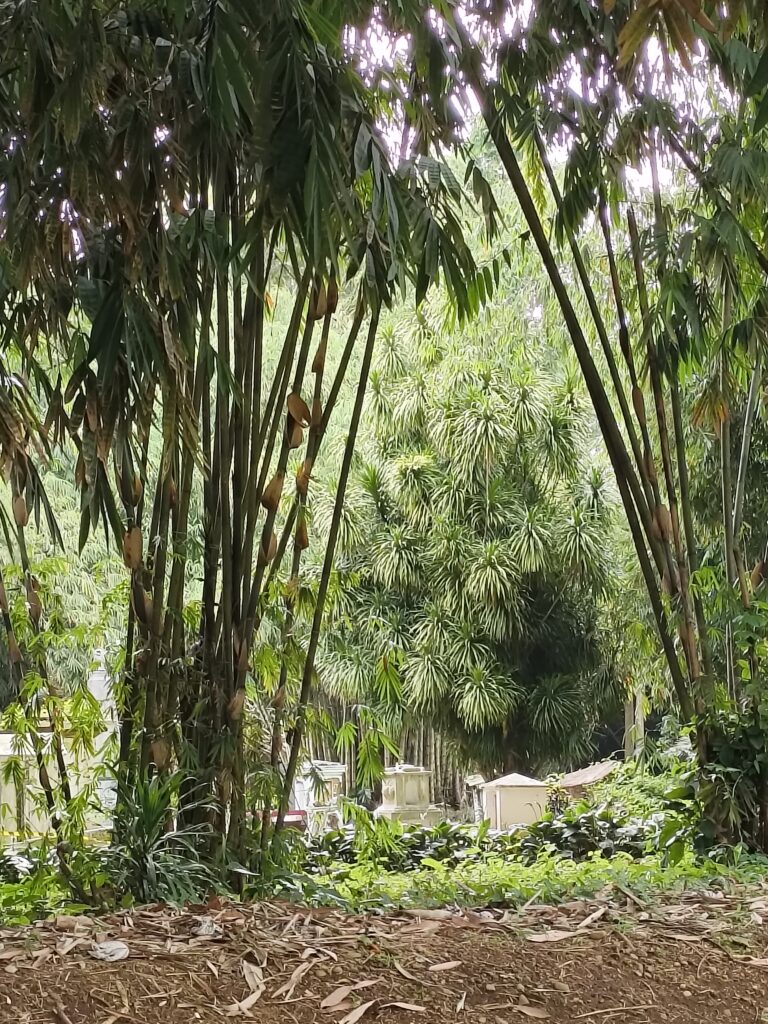
Inside the Botanical garden you’ll also find one of the six Presidential Palaces. The Istana Bogor. Besides that, it is also housing former President Sukarno’s Art collection.
TravelTips: A collection you can admire, but only after submitting a formal request to the Head of the Presidential Household. Not as easy as you would like from abroad.
Within the garden are located several restaurants, like the Grand Garden Cafe/ Resto Raasaa. Besides a complete menu, this place provides a beautiful view over part of the garden.
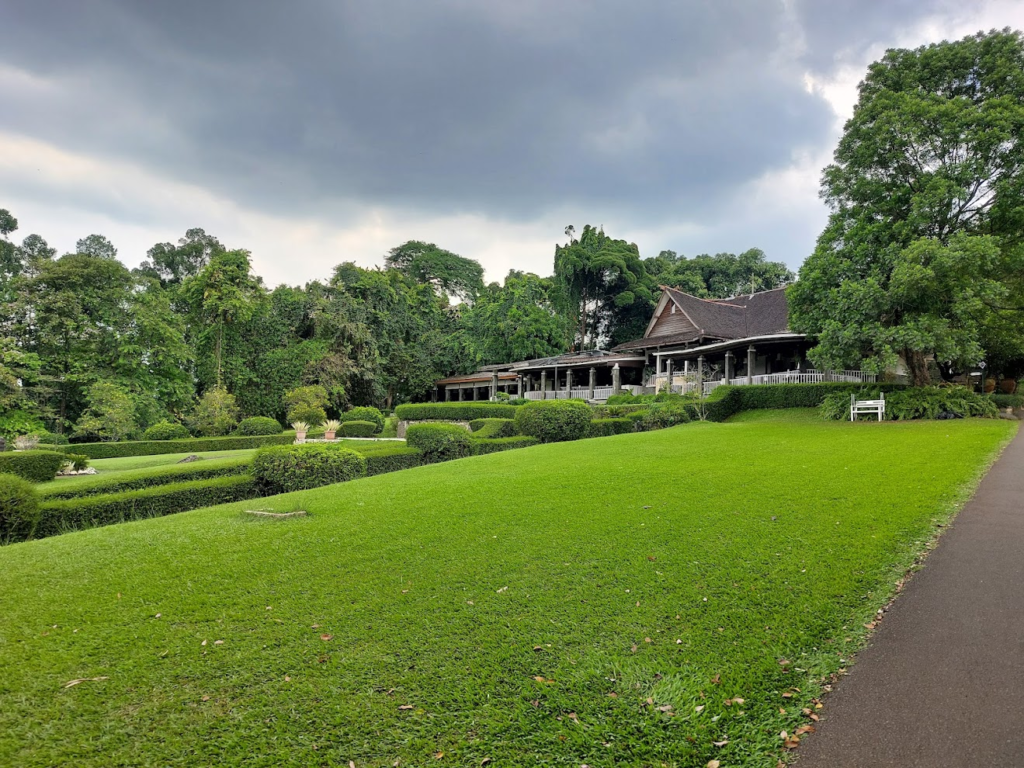
- Opening hours of the Botanical garden: 7h30am – 5h00pm. However, the Grand Cafe is open from 9h00am until 11h00pm.
Near the entrance there’s a small souvenir shop.
TravelTips: To get around in the Botanical garden you can – besides walking – rent a bike, a scooter or even a mini car.
Guided tours are usually available for an additional fee if you want a more in-depth understanding of the garden’s collections. Just ask for a guide at one of the entrances.
From Jakarta
For those of you who don’t plan to stay in Bogor, there are well organized tours from Jakarta. Mostly combining a visit to the Botanical garden with other attractions nearby.
To learn more, click on: A visit to the Botanical Garden from Jakarta
Batutulis
The second day we spent mainly in Batutulis. A big neighborhood just South of the Botanical garden. Our first introduction to the way most people live in Java/Indonesia.
That is, in small, lively close-knit communities. Besides housing, also provided with small stores & food stalls (warungs). Generally emitting a friendly & safe feeling to every visitor.
- Officially Batutulis can be described as a Kelurahan, a collection of smaller urban communities called Kampungs. While the rural counterpart of a cluster of communities is called a Desa.
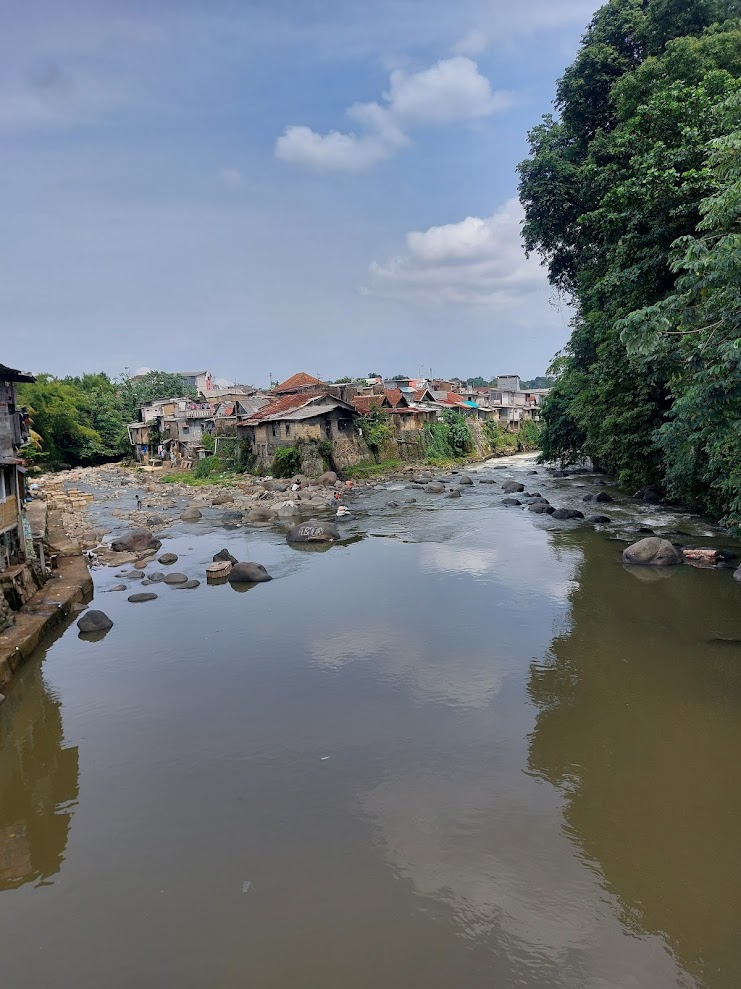
These kampungs are also characterized by pathways which are too narrow for cars or buses. However, open to the many scooters which almost every Indonesian citizen has as its disposal. Adults & often adolescents as well.
- The scooter is the main transport in Java & the other islands of Indonesia. With every red traffic light hundreds of them gather in front of the cars and win the race going home or elsewhere.
A personal quest
In our case we had a special reason to explore Batutulis. During & after the Second World War my father-in-law was living there with his grandparents. A “home” we knew beforehand was hidden in a labyrinth-like part of Batutulis.
Pathways so narrow we sometimes had to pass what seemed like private courtyards. Crossing rickety, creaking bridges over too shallow, smelly expanses of water.
In short, a visibly poor neighborhood, sprinkled with household rubbish here & there. Loving the adventure though. Mainly because the inhabitants – although surprised by our visit – were overly friendly & welcoming.
In the end finding the house Wen’s great-grandparents lived their lives long ago. Closed in by other constructions nowadays, but still a very special unforgettable moment for the both of us.
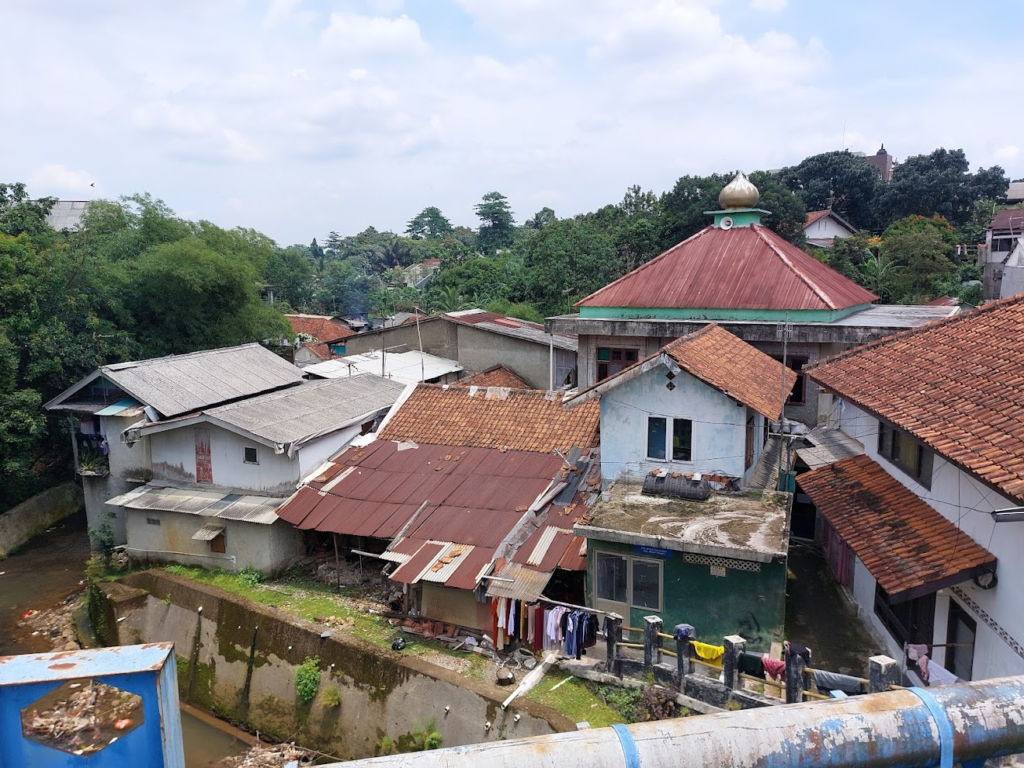
- At the time, over 90 years ago, Batutulis was still separated from Bogor’s city center and the houses had more space around them. Green areas in front and at the back generally.
In the end the visit to Batutulis was one of the personal highlights of our trip through Java.
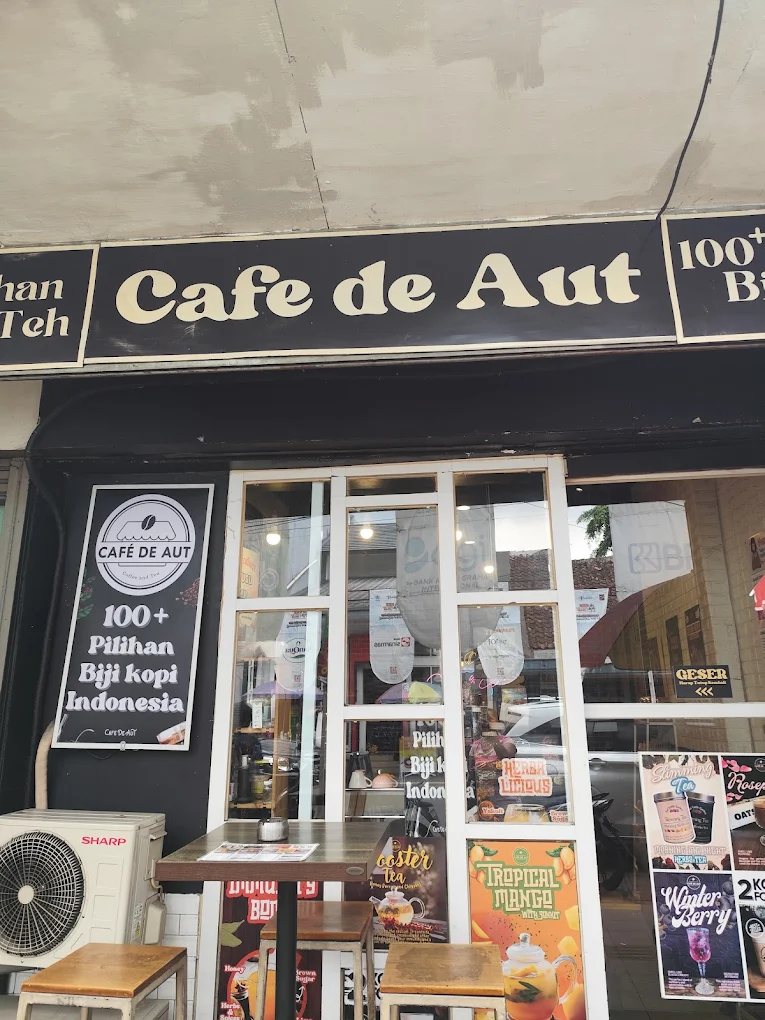
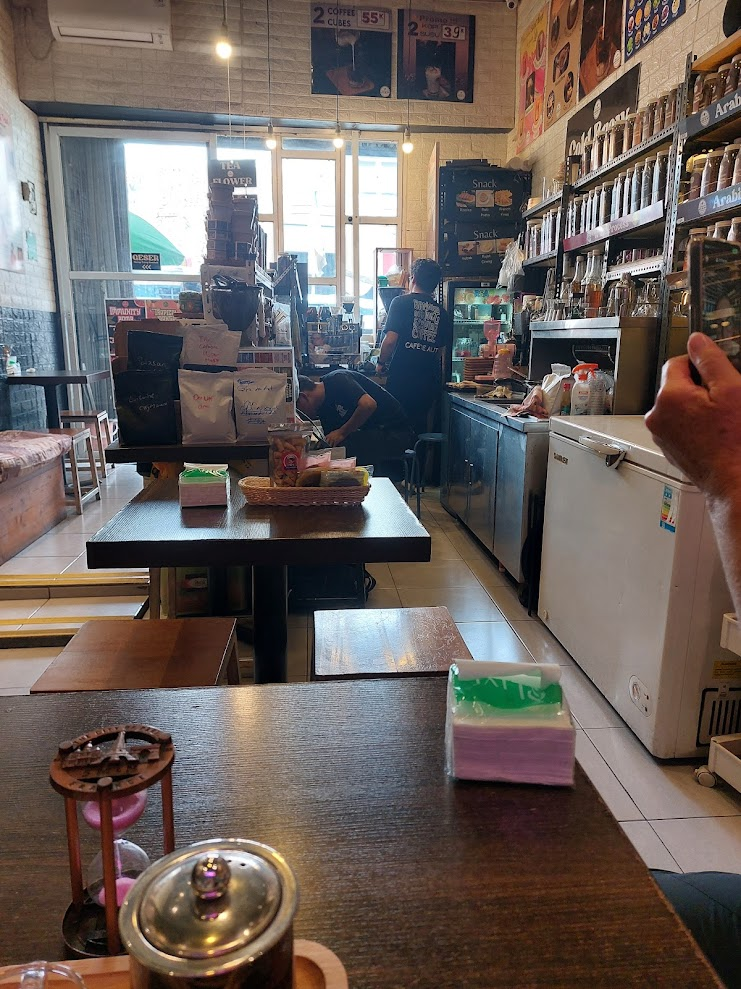
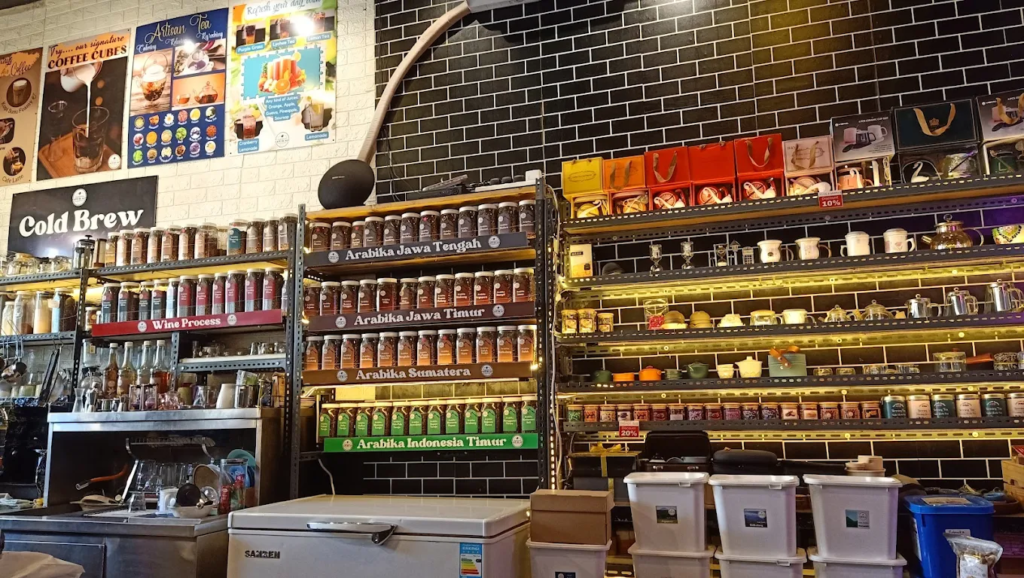
TravelTip: (provided by a traveling friend): When exploring Batutulis, try to find the Cafe de Aut. A small but cozy cafeteria, serving a wide variety of coffee & tea. We used it as a well deserved break of our personal quest.
The Prasasti Batutulis
Within the neighborhood you can visit the Prasasti Batutulis. A monumental stone or stele, inscribed with a dedication to Sri Baduga Maharaja (1482-1521). A Sundanese king who according to tradition had mystical powers.
- Actually Batutulis is named after this historic monument. One of many steles & inscribed stones in Java, which span different eras & kingdoms.
The shrine is located about 2.5 km/ 1.6 miles from the Botanical garden. Easily reachable on foot.
Pasar Baru
On our way back we visited the Pasar Baru. That’s partially, because it’s a large indoor/outdoor market. A perfect chance to get an idea of the products people need for their daily life in Bogor.
Besides fresh produce, on this market you can also find all kinds of household goods, as well as clothes, local handicrafts & typical snacks.
TravelTip: Although you may consider certain products cheap, it’s permitted – and often even expected – to negotiate a better price.
Visit Bogor: Where to stay
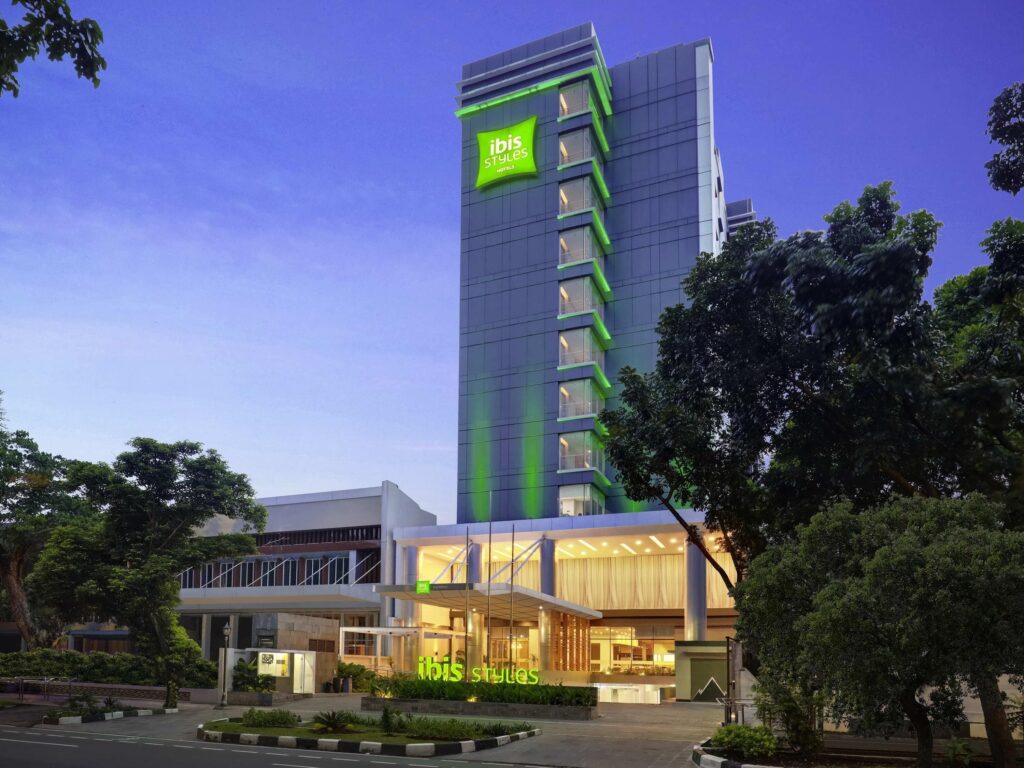
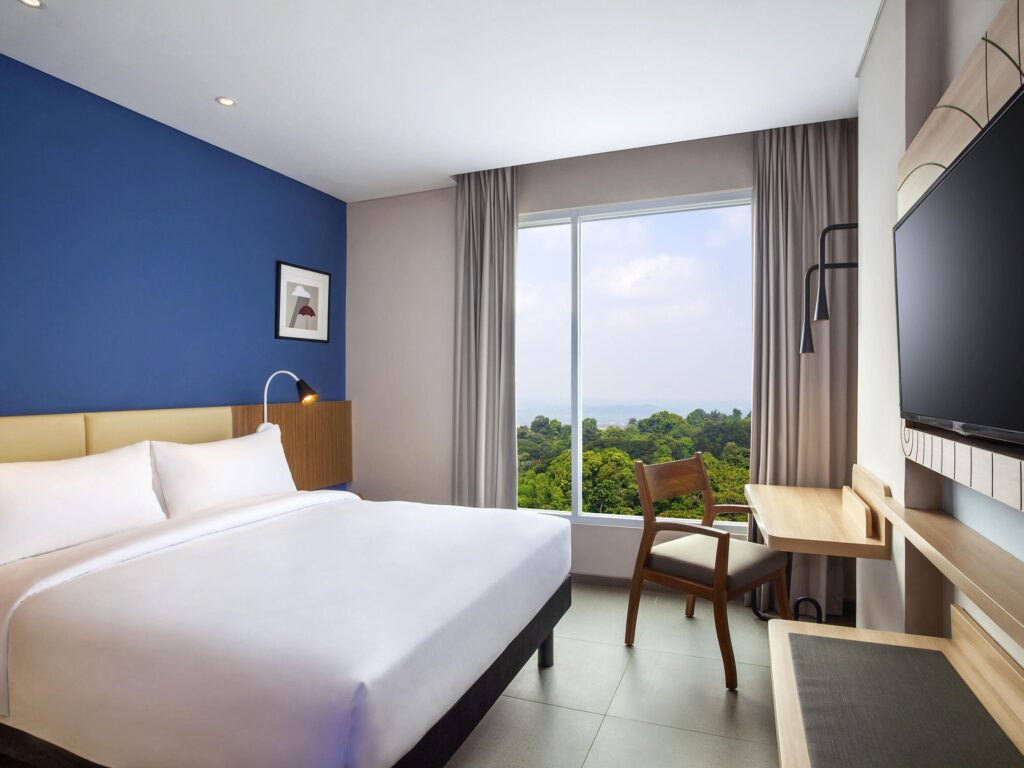
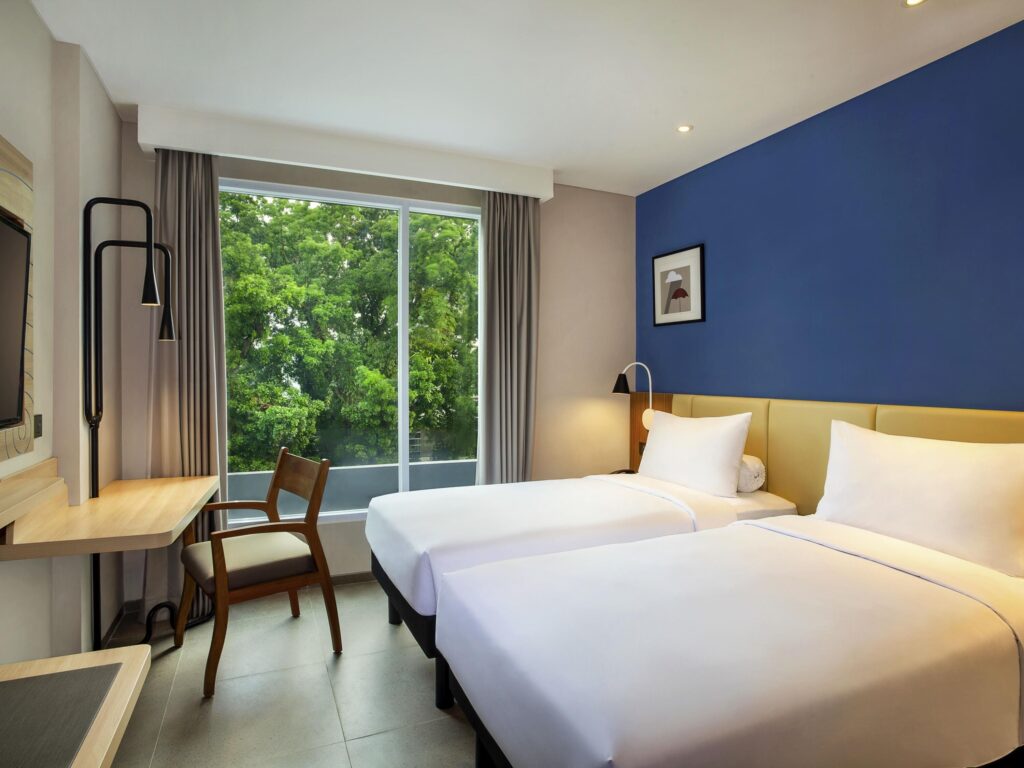
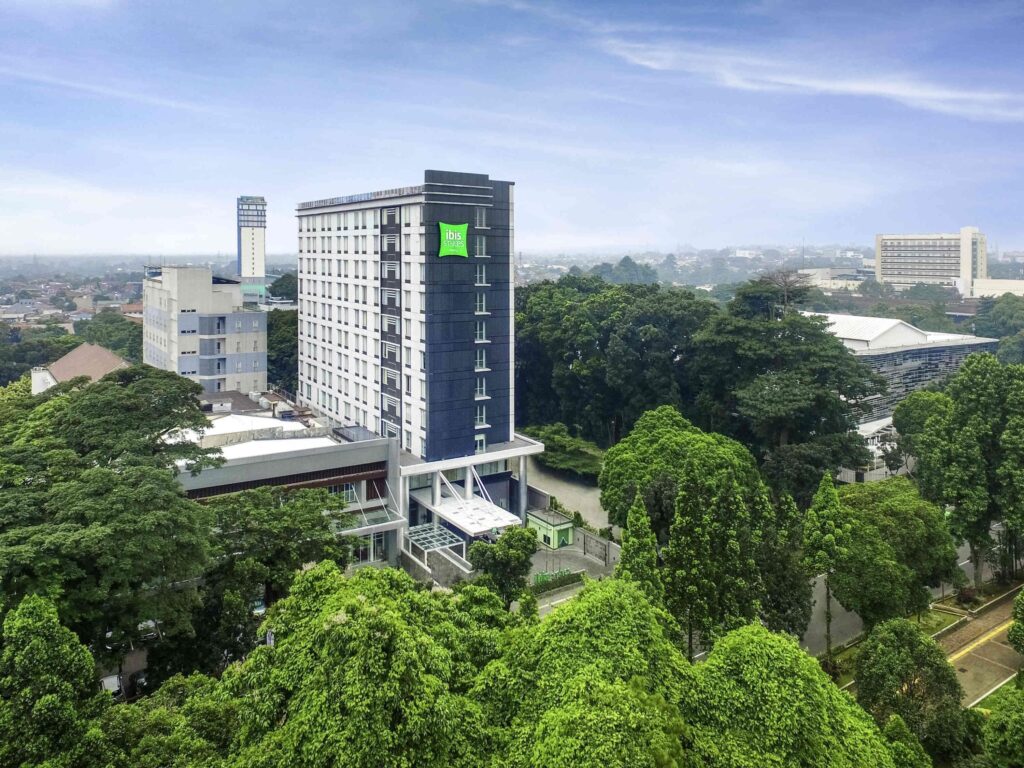
There are many hotels in Bogor, but I’d like to recommend a hotel we had chosen beforehand: the ibis Styles Bogor Pajajaran.
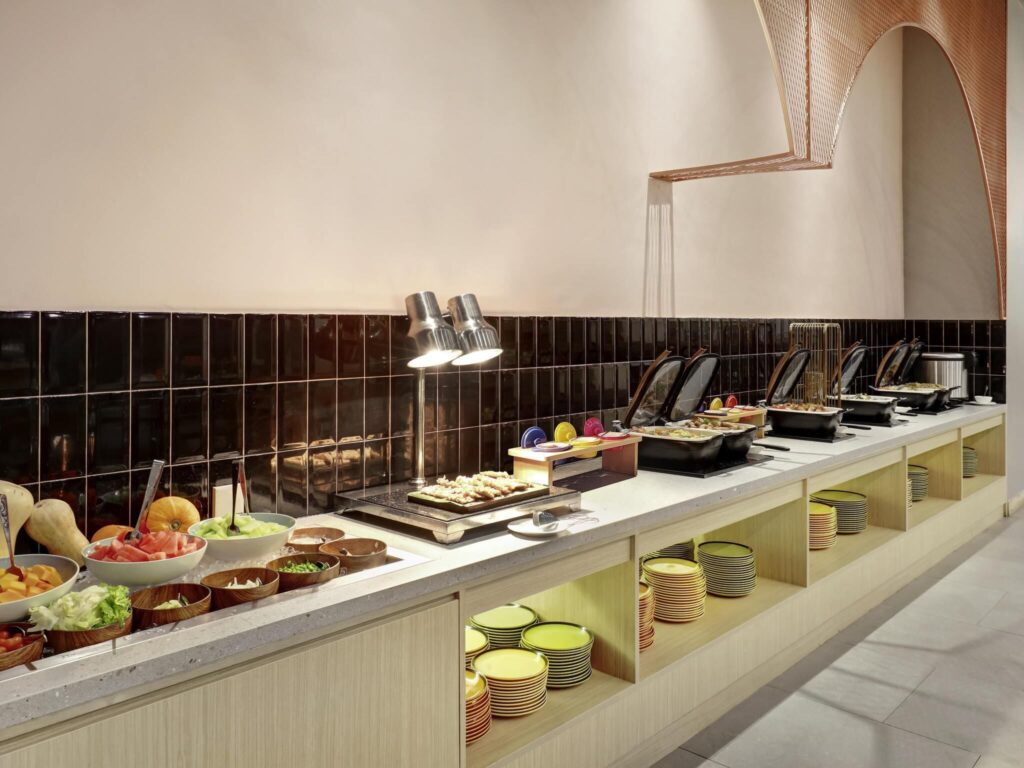
A safe place, with a great location – right across from the botanical garden – friendly staff & a good restaurant at a fair price.
- The room price includes an excellent, varied breakfast buffet.
!!! An extra advantage of staying in this hotel was the proximity of a pedestrian tunnel nearby. The only one to cross over the 4-lane road which circles the Botanical garden.
A luxury in a country where pedestrians – at least in the inner cities & outside the kampungs – seem to have been declared outlaws. You rarely encounter a traffic light for pedestrians to cross the busy main roads.
- And another plus.. we arrived late at the hotel from the Jakarta International Airport, but – although the restaurant was closing – could still order a hearty first meal in Indonesia.

To learn more, click on the following link or the picture below:
Visit Bogor: Getting around
From the Soekarno-Hatta International Airport (CGK)
The nearest International Airport is the Soekarno-Hatta Airport (CGK).
Depending on traffic, a taxi normally will take 1.5 hours to Central Bogor & will cost between $35-40.
- Be aware though, the ride will take longer when you travel during rush hours in & around Jakarta. Rush hours are usually between 7 & 10 AM and 4 & 7 PM on weekdays.
TravelTip: Use an official taxi company like Grab, Bluebird or Gojek. All of them use apps.
- Overall we used the Grab-app the most during our trip through Java & Bali. Worked perfectly! Professionally, affordable & safe.
Alternatively you can take a bus, which is much cheaper DAMRI – from $4 (depending bus type & class) – but takes 2 hours to Bogor.
Or a train, but if you choose this option you first have to go to Central Jakarta. And when there, transfer to another train.
Personal choice: We ourselves took a taxi from the Jakarta International Airport to Bogor. Arranged this time by the ibis Styles Bogor Hotel. Besides affordable, it was the easiest & safest way to get there with our luggage.
Our choice to go first to Bogor instead of Jakarta was for two reasons:
- We wanted to acclimatize a little, before visiting the busy, hectic capital.
- Secondly, after Jakarta we planned to head on to Yogyakarta and learned beforehand there is a direct train connection from Jakarta, but not from Bogor.
TravelTip: After arriving at the airport, getting through customs & migration we bought SIMcards at the TelkomCel stand at the Exit. Good service, as the sellers helped us install the card & made it function.
From the Domestic Halim Perdanakusuma Airport (HLP)
If you arrive with a flight at the Domestic Airport of Jakarta you can either take a taxi or – much cheaper – a direct bus (DAMRI) to Bogor. Both normally taking around 45 minutes.
Getting around in Bogor itself
There are many ways to get around in Bogor. Depending also on where you are staying & where you want to go.
Instead of treating them all, I’d highly recommend you to consider using a taxi service. Or else, if you don’t have to go that far consider a motorbike taxi (Ojek). Cheaper & often quicker.
That is, besides walking of course – to explore the city at your own pace. A choice which can be a challenge. Certainly because pedestrians are somewhat of a curiosity in Bogor & many other places in Indonesia.
In the end, we walked a lot, but used taxis also. A relatively cheap option.
TravelTip: Use an official taxi company (Grab, Bluebird or Gojek), for a guaranteed price. And – if happy with the service – you may tip the driver. A 10% is a good estimate (rounding up the fare).
TravelTip: Take into account that most Indonesians in Java don’t speak English. Better bring a map or an address. Or study Bahasa, if you can/like.
Besides a (motorbike) taxi, you can also take a local bus or a minivan (Angkot) to get around town. Be aware though, besides studying the routes, for some bus lines you’re going to need an electronic/e-money card.
Visit Bogor: In Conclusion
We stayed 3 nights in Bogor & enjoyed the place enormously.
First of all, to get a feel with the country & prepare ourselves for the next stop, the capital of Jakarta.
Besides that, we had made a long trip to get to Indonesia. Almost 72 hours from Ecuador, with beautiful, but intensive stopovers in Amsterdam & Istanbul.
Furthermore, we had a personal reason to stay a little longer in Bogor. Exploring the Batutulis area for family roots, which we happily found in the end.

In that sense we both agreed: a first stop in Bogor was a perfect choice. And the beautiful Botanical garden is an ideal place to acclimatize & start a journey through Indonesia.
In addition, Batatulis gave us a good first impression of how cities on Java are structured. The famous Kampungs, small communities. And how the inhabitants live there.
People who often live on an economic low, but are generally extremely friendly & helpful, if needed.
In the end, we visited the Botanical garden 3 days in a row.
- The first day, being the main attraction!!! Also a beautiful Sunday, with lots of local families & young couples in love visiting.
- The second, after exploring Batutulis.
- And the last day, before heading out to Jakarta.
Every visit, enjoying the gardens, as well as a break at the Grand Garden Cafe. A good cup of coffee and/or a tasty meal or snack.
In short, I highly recommend a visit to Bogor. Preferably for a few days, but at least one day from Jakarta if time is too short for you to stay there.
Overview Indonesia Trip:
To get an idea of all the major destinations we visited on Java & Bali, Indonesia you can click on the following names:
JAVA
- Jakarta
- Yogyakarta (under construction)
- Surakarta/Solo (under construction)
- Semarang (under construction)
BALI
- Pekutatan (under construction)
- Ubud (under construction)
- Sidemen (under construction)